The gap between knowing and fixing

Tell a team to make their tickets smaller and you'll hear: "Yes, but releasing wastes too much time." "Yes, but QA is the real bottleneck." "Yes, but the other team blocks us." They're usually right. And that's exactly the point.

Recadence doesn't just measure cycle time and leave teams to figure out why it's long. It traces every ticket through its entire lifecycle, correlates hundreds of behavioural signals across sprints, and surfaces a structured root cause analysis deep enough to answer every "yes but" with evidence, every sprint.

That's why the company is called Yes But How.
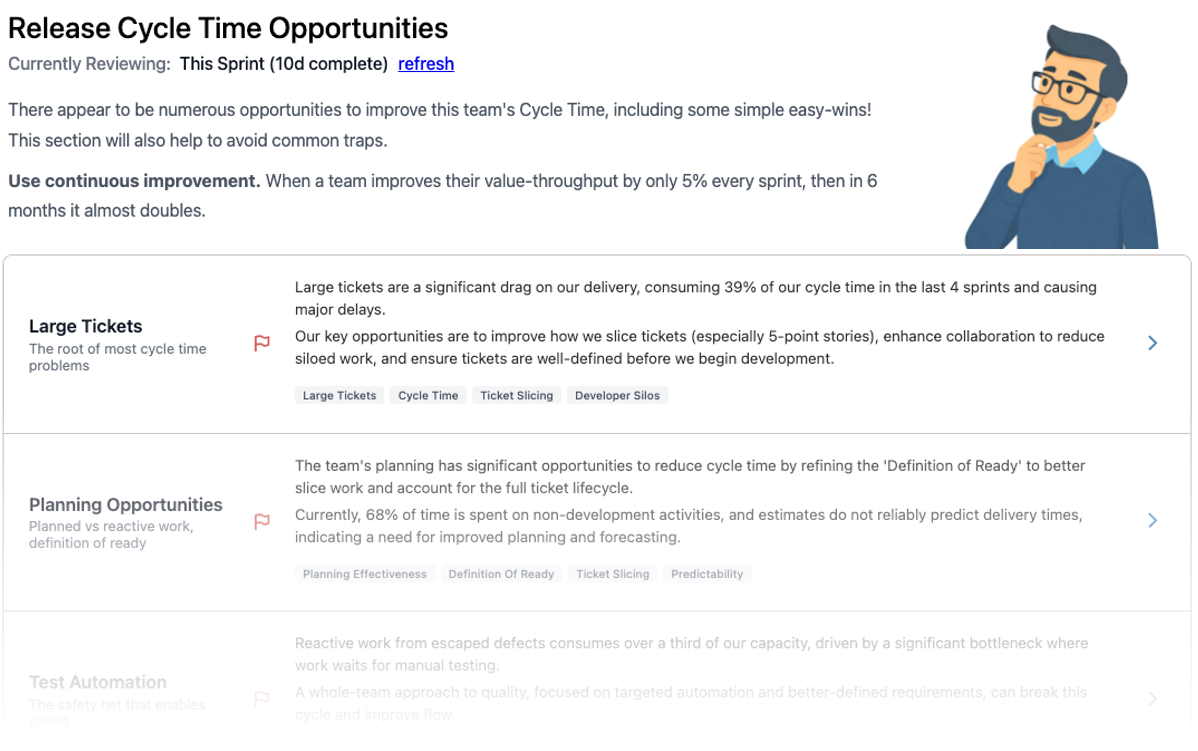
Release cycle time opportunities showing root cause analysis across large tickets, planning, and more

Beyond these top-level summaries, each focus area has a two-minute brief with tailored recommendations specific to the team's data. Underneath that are 10-15 minute guides in each section filled with predictive analytics, data insights, and learning materials in context with the team's actual problems - not a list of books they have to read.

The symptoms vary, but the remedies are often consistent: how to improve incrementally without big-bang releases, how to avoid the common pitfalls, how to articulate as well as measure impact, and the relevant theory behind their numbers.

Each team will independently know exactly what is happening, why it is happening, and what to change to achieve measurable improvement.

See how it works in detail

What changes for teams

Transparency, not predictability

Agile doesn't make delivery predictable. It makes it transparent. When cycle times are short, scope changes become cheap course-corrections instead of expensive surprises. "When will it be done?" becomes "what should we focus on next?"

Evidence to articulate problems they can't control

External blockers, cross-team dependencies, and reactive distractions become measured and visible. Teams can show exactly what's within their control and what isn't. The conversation shifts from blame to support.

Improvement they own

Lives inside Jira. Used in retros. When a team addresses a specific bottleneck and their cycle time improves, that improvement shows up in the next sprint. Celebrate it in the demo and do it again.

Proof that improvement is real

When cycle time comes down, it's data, not opinion. When QA wait times halve because the team invested in automation, the before and after are right there. Improvement stops being theoretical.

Signals that help engineering leaders enable, not micro-manage

Structural health signals

A small set of indicators that tell you when something needs attention: external blockers growing, WIP creeping up, reactive work consuming too much capacity, defect backlogs building. Know when to offer support without chasing updates.

Four balanced metrics

Release cycle time, tickets released, defect rate, defect recovery time. These balance each other. They tell you whether a team is genuinely improving or just moving the problem somewhere else.

Demos that aren't terrifying

When cycle time is short, teams have finished, released work to show. External blockers are already visible. Demos stop being an inquisition and start building real trust.

A baseline before you change anything

AI adoption, acquisitions, reorgs, cost pressure. You need to know how work actually flows today before measuring whether an intervention helped. Recadence gives you that baseline in five minutes.

Not every team starts in the same place

A blanket approach will fail. Recadence shows you which teams need what, across your entire portfolio, without depending on self-reporting.

Fine-tuning

Already working in small tickets with short cycle times. They need tighter feedback loops, better slicing, specific bottleneck removal.

Diagnosis

Large tickets, long cycle times, but the discipline and capability to change. Show them where the time goes, and they'll fix it.

Fundamentals

Planning is broken, processes are inconsistent. They need the basics before cycle time optimisation makes sense.

One intervention. Everything else follows.

Make the tickets small. Measure how long they take. Show the team exactly what's slowing them down. Let them fix it. Demo the results.

Everything else follows.

Recadence connects to your Jira and makes this visible in five minutes. No code access. No repo permissions. Just your tickets, analysed, and a team conversation that starts with evidence instead of opinions.

See the whole picture of your team's delivery

We'll connect your Jira on a quick setup call and walk you through your first analysis. Five minutes, your data, no slides.

Connect your data
Watch a demo